
Rock Cycle Diagram
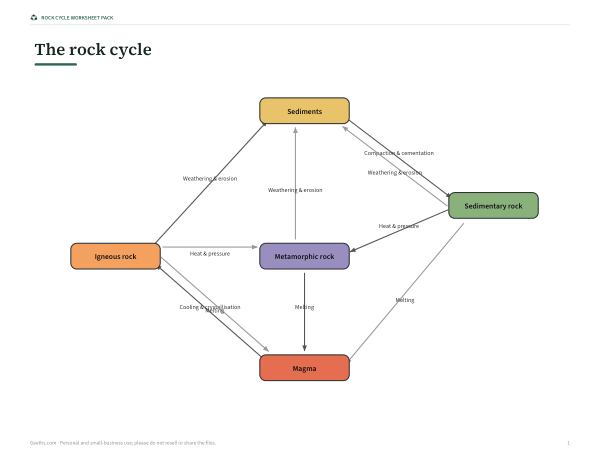
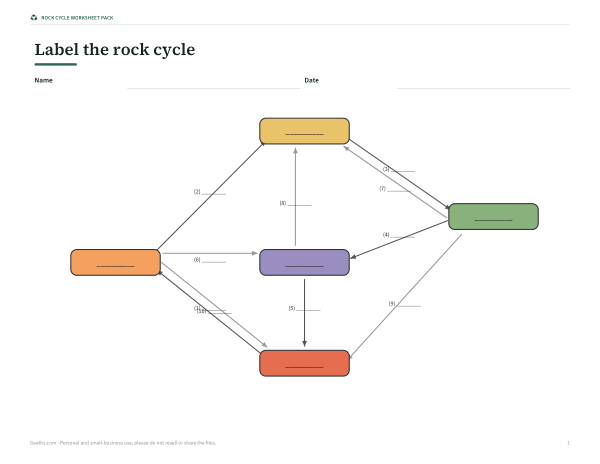
Rocks are constantly being recycled. Click any part of the rock cycle diagram to see how that rock forms and what can happen to it next, follow the arrows between igneous, sedimentary and metamorphic rock, and test yourself with the “what process changes this rock?” quiz. Printable labelled and blank diagrams are included in the worksheet pack.
- Free to use
- No sign-up
- Runs in your browser
Interactive rock cycle
Quiz
Rock Cycle Worksheet Pack
Printable labelled rock cycle diagram, a blank labelling worksheet with answers, a rock identification chart, a rock cycle sequencing activity and a rock collection log.
- Labelled diagram (PDF)
- Blank worksheet (PDF)
- Rock ID chart (PDF/XLSX)
- Questions (PDF, DOCX)
- Collection log (XLSX)
Formats: PDF, XLSX, DOCX. Instant download after payment (link valid 72 hours, up to 5 downloads). AI-assisted: the templates were drafted with AI help and reviewed and laid out before publishing.
$3.00 USD, one-time 5 files · about $0.60 each
- Instant download
- 7-day refund
- Secure checkout by Stripe
7-day money-back guarantee. Full refund within 7 days of purchase, even after you download.
Free sample: Rock Collection Log (PDF, 59 KB)
Full refund within 7 days — see the refund policy and license.
Free printables
Single sheets you can print right now, no sign-up. The full pack adds every sheet in one download plus the editable files.
 Printable Rock Cycle Questions
 Printable Rock Collection Log
What the rock cycle is
The rock cycle describes how the three main types of rock — igneous, sedimentary and metamorphic — form, break down and change into one another over millions of years. There is no fixed starting point or order: any rock can become any other type given the right conditions. Energy from Earth’s internal heat drives melting and metamorphism, while energy from the Sun drives weather, water and ice that break rocks down at the surface.
The three rock types
| Type | How it forms | Clues to identify it |
|---|---|---|
| Igneous | Cooling and solidifying of magma or lava | Interlocking crystals; no layers; sometimes gas bubbles or glassy texture |
| Sedimentary | Compaction and cementation of sediments, or precipitation from water | Layers, rounded grains, fossils; often softer |
| Metamorphic | Heat and pressure change existing rock without melting it | Bands or sheets (foliation), sparkly minerals, very hard |
The processes, step by step
- Melting — deep underground, high temperatures melt rock into magma.
- Cooling and crystallisation — magma cools; minerals crystallise to form igneous rock.
- Weathering — rock at the surface is broken down by water, ice, wind, temperature changes, plants and chemicals.
- Erosion and transport — rivers, waves, glaciers and wind carry the pieces away.
- Deposition — sediments settle in layers, often in lakes, seas and river deltas.
- Compaction and cementation — buried layers are squeezed and glued by minerals into sedimentary rock.
- Heat and pressure — deep burial or mountain-building changes rock into metamorphic rock.
- Uplift — tectonic forces raise rocks back to the surface, where weathering begins again.
Examples of common rocks
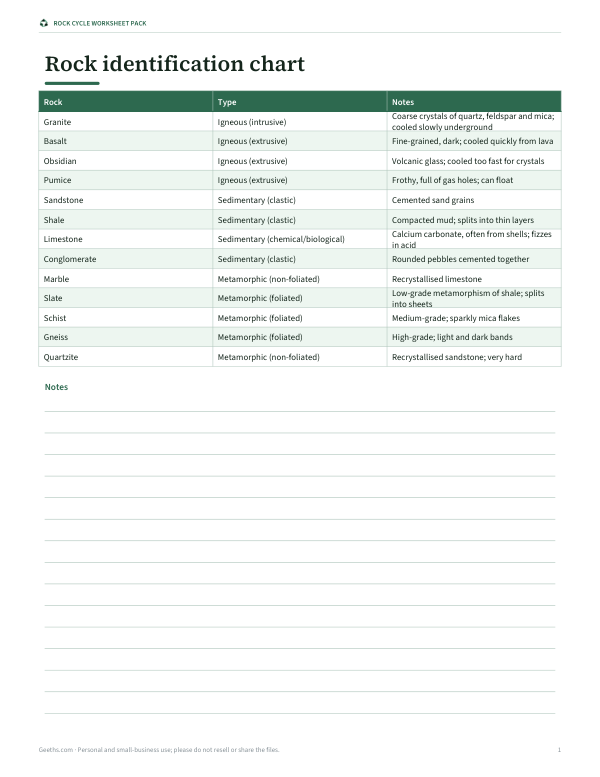
| Rock | Type | Notes |
|---|---|---|
| Granite | Igneous (intrusive) | Coarse crystals of quartz, feldspar and mica; cooled slowly underground |
| Basalt | Igneous (extrusive) | Fine-grained, dark; cooled quickly from lava |
| Obsidian | Igneous (extrusive) | Volcanic glass; cooled too fast for crystals |
| Pumice | Igneous (extrusive) | Frothy, full of gas holes; can float |
| Sandstone | Sedimentary (clastic) | Cemented sand grains |
| Shale | Sedimentary (clastic) | Compacted mud; splits into thin layers |
| Limestone | Sedimentary (chemical/biological) | Calcium carbonate, often from shells; fizzes in acid |
| Conglomerate | Sedimentary (clastic) | Rounded pebbles cemented together |
| Marble | Metamorphic (non-foliated) | Recrystallised limestone |
| Slate | Metamorphic (foliated) | Low-grade metamorphism of shale; splits into sheets |
| Schist | Metamorphic (foliated) | Medium-grade; sparkly mica flakes |
| Gneiss | Metamorphic (foliated) | High-grade; light and dark bands |
| Quartzite | Metamorphic (non-foliated) | Recrystallised sandstone; very hard |
Plate tectonics and the rock cycle
Plate tectonics powers much of the cycle. At subduction zones one plate sinks beneath another; rock melts to feed volcanoes, and the collision squeezes and heats surrounding rock into metamorphic rock. Where plates collide to form mountains, rocks are uplifted, exposed and weathered. At mid-ocean ridges, magma rises to form new igneous crust. Without plate movement, rocks would mostly just erode flat.
Worked example: a grain of sand’s journey
A granite mountain (igneous) weathers over thousands of years; quartz grains wash down a river to the sea and settle as sand (sediments). Buried under more layers, the sand is compacted and cemented into sandstone (sedimentary). Much later, the sandstone is carried deep during mountain-building and heated and squeezed into quartzite (metamorphic). If it goes deeper still, it may melt into magma — and the cycle continues.
Using the interactive diagram
- Click each rock type to read how it forms and what it can become.
- Trace a path with your finger and describe each process aloud.
- Use the quiz to test yourself on which process connects two stages.
- Print the blank diagram from the pack and label it from memory.
- Collect local rocks and try to place them in the cycle.
Identifying rocks at home
| Test | What it tells you |
|---|---|
| Look for crystals | Visible interlocking crystals suggest igneous or metamorphic rock |
| Look for layers | Flat layers or fossils suggest sedimentary rock |
| Look for bands | Wavy light and dark bands suggest gneiss (metamorphic) |
| Scratch test | Quartz-rich rocks scratch glass; soft rocks like shale can be scratched with a coin |
| Acid test | A drop of vinegar fizzing shows calcite — limestone or marble |
| Weight and texture | Pumice is very light; basalt is heavy and fine-grained |
Do tests with an adult, wash hands afterwards and never test rocks from protected sites. Collect only where it is allowed.
Rock cycle vocabulary
- Magma — molten rock below the surface; lava when it erupts.
- Intrusive — igneous rock that cooled underground; extrusive — cooled at the surface.
- Clastic — sedimentary rock made of broken pieces of other rocks.
- Foliated — metamorphic rock with aligned minerals in layers or bands.
- Lithification — turning sediment into rock by compaction and cementation.
How long does the rock cycle take?
Some steps are fast — lava can cool into basalt in hours or days — while others take millions of years, such as burying sediment deep enough to become rock or lifting metamorphic rock back to the surface. The full cycle for a particular piece of rock can take hundreds of millions of years, and some rocks skip steps entirely.
Privacy
The diagram runs in your browser.
Frequently asked questions
What are the three types of rock?
Igneous, sedimentary and metamorphic.
How does sedimentary rock form?
Sediments are deposited in layers, buried, compacted and cemented together.
What turns rock into metamorphic rock?
Heat and pressure that change minerals without melting the rock.
Can metamorphic rock become igneous rock?
Yes, if it melts into magma and then cools.
What drives the rock cycle?
Earth’s internal heat and plate tectonics, plus weathering driven by the Sun, water and gravity.
Is there a start to the rock cycle?
No, it is a cycle; any rock can change into another type.
What is the difference between weathering and erosion?
Weathering breaks rock down in place; erosion carries the pieces away.
Where do metamorphic rocks form?
Deep underground, often where plates collide and mountains form.
Is anything stored?
No, it runs in your browser.